water Clean.
watts Green.
waste Lean.
DEIONIZATION
w3Synergy designs and supplies deionization equipment to achieve ultrapure water (i.e. resistivity of 18 MΩ-cm) using either ion exchange resin demineralization (DI) or Electrodeionization (EDI).
Demineralization (DI)
w3Synergy DI systems are engineered to be “plug & play” (i.e. pre-plumbed, pre-wired and mounted on steel-frame skid). The footprint of w3Synergy skids can be customized to fit the available space within the project site.
Standard DI systems include:
• Composite fiberglass (FRP) vessel(s)
• Media (ion exchange resin)
• Control valves
• Controller
• Pressure gauges
• Powder-coated steel frame

Electrodeionization
EDI technology combines electrodialysis and ion exchange technology to remove ions from the feed water. It is both effective and efficient because the EDI module is continuously recharged through the electric current from the unit.
The EDI process uses a combination of ion-selective membranes and ion-exchange resins sandwiched between two electrodes (anode (+) and cathode (-)) under a DC voltage potential to remove ions from RO-pretreated water.
Ion-selective membranes operate using the same principle and materials as ion exchange resins. Anion-selective membranes are permeable to anions but not to cations; cation-selective membranes are permeable to cations but not to anions. The membranes are not water-permeable.
By spacing alternating layers of anion- and cation-selective membranes within a plate-and-frame module, a “stack” of parallel purifying and concentrating compartments are created. The ion-selective membranes are fixed to an inert polymer frame, which is filled with mixed ion-exchange resins to form the purifying chambers. The screens between the purifying chambers form the concentrating chambers.
This stack of cell-pairs is positioned between the two electrodes, which supply the DC potential to the module. Under the influence of the applied DC voltage potential, ions are transported across the membranes from the purifying chambers into the concentrating chambers. Thus, as water moves through the purifying chambers, it becomes free of ions. This is the pure water product stream.
w3Synergy EDI system consists of the following components:
-
EDI Module
-
DC Power
-
Controller with user interface
-
Instrumentation (pressure, temperature, flow, resistivity)
-
Powder-coated steel frame

Degassifier
In source waters containing elevated dissolved carbon dioxide, a membrane contactor degassifier may be used upstream to enhance the effectiveness of DI or EDI in the presence of dissolved carbon dioxide.
Membrane contactors are also used as a Deaerator for the removal of dissolved oxygen from boiler feedwater to protect boilers from corrosion and in brewery process operations where the presence of oxygen is detrimental to the flavor stability of beer.
A Membrane Contactor allows dissolved gases to pass through a hollow fiber membrane while retaining the water. A vacuum applied to the inside of the fibers creates the driving force for dissolved gas in the liquid to pass through the membrane pores and be swept away by the vacuum pump.
w3Synergy’s membrane contactor skid consists of the following components:
-
Membrane contactor(s)
-
Vacuum pump
-
Control valves
-
Controller with user interface
-
Instrumentation (pressure, temperature, flow)
-
Powder-coated steel frame

Automation & Monitoring
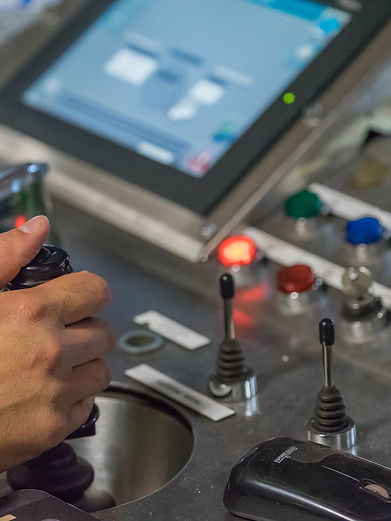
w3Synergy EDI systems can fully automated with the option of either Allen Bradley, Siemens or Idec PLC. Automation allows for remote continuous online monitoring & control.
Available on-line instrumentation includes:
-
Temperature
-
Resistivity
-
Conductivity
-
Pressure
-
Flow
-
Dissolved CO2 analyzer
Dissolved O2 analyzer