water Clean.
watts Green.
waste Lean.
MEMBRANE SEPARATION
w3Synergy designs and supplies a broad range of membrane separation equipment; in fact, membrane separation is often the “workhorse” of most w3Synergy water treatment systems. Membranes purify the source water by removing the dissolved solids (solute) including salts, minerals, anions, and cations. The porosity of membranes ranges from ultrafiltration (0.01 micron) to nanofiltration (0.001 micron) to nonporous reverse osmosis (0.0001 micron).
Ultrafiltration
Ultrafiltration is used to remove suspended solids (TSS), colloidal material, and log removal of microorganisms and pathogens including giardia, crypto, viruses and e. coli.
Ultrafiltration (UF) separation utilizes low pressure membranes (feed pressure around 30 psig) to remove particulate and microbial contaminants. (Note, UF will not remove ions or molecules of low molecular weight.)
During filtration mode, 100% of the feed water is converted to filtrate. This is also referred to as dead end filtration. As contaminants are removed and deposited on the hollow fiber membrane surface during the operating step the transmembrane pressure will rise. At the end of the preset operating cycle time, a backwash sequence commences.

w3System – Packaged Membrane Skids and Containers
w3Synergy membrane systems are engineered to be “plug & play” (i.e. pre-plumbed, pre-wired and mounted on steel-frame skid). w3Synergy systems range in capacity from 1000 gallons per day (GPD) to 1 million GPD. The footprint of w3Synergy skids can be customized to fit the available space within the project site. Also available installed within 20-ft and 40-ft shipping containers (Conex box).
Standard w3Synergy membrane systems feature:
• Membrane fiberglass (FRP) vessel(s)
• Membranes (e.g. reverse osmosis, nanofiltration, ultrafiltration)
• Pre-filter housing (cartridge microfiltration)
• Pressure pump
• Controller with user interface
• Instrumentation (pressure, temperature, flow, conductivity)
• Powder-coated steel frame
Options available to customize the w3Synergy systems include:
• Holding tank(s)
• Pretreatment system (e.g. media filtration, softener)
• Chemical Injection systems (e.g. anti-scalant, dechlorination)
• Post-treatment system (e.g. pH adjustment)
• Disinfection system (e.g. UV disinfection)
• Demineralization system (e.g. electrodeionization EDI)
• Double-pass RO
• Concentrate recovery system
• Variable frequency drives for pump motors
• Integrated Clean-In-Place (CIP) system
• Sanitary and Hygienic design
• Stainless steel frame

Nanofiltration
Nanofiltration (NF) membranes are tighter than UF membranes but looser than RO membranes. NF is used to remove color due to dissolved organics and soften water by removing hardness ions (calcium & magnesium). Nanofiltration is also used to remove other divalent ions such as sulfate. In addition, nanofiltration (as well as reverse osmosis) has been extremely effective at removing PFAS.
Nanofiltration membrane(s) separates the feed solution into two streams, a concentrate (retentate) and a permeate (filtrate). The NF membranes are available in a range of pore sizes that can be used to selectively remove solutes based on the molecular weight cutoff (Dalton) of the solute. For example ranges within 100-250 Da, 150-300 Da, 300-500 Da, 600-800 Da, etc.
Diafiltration is a process used in biotech and advanced materials industries to purify the product in the retentate/concentrate by further removal of salts. With diafiltration, deionized (DI) water (sometimes with a buffer) is introduced to the feed tank typically at a continuous rate equal to the rate the filtrate is removed. The retentate captures the product while excess water, aniline and surfactant are separated in the filtrate stream. The retentate returns to the feed tank and is cycled again thru the membrane. This process is repeated several times until an optimal point is reached with respect to declining flux and increasing transmembrane pressure (TMP).

Reverse Osmosis
The reverse osmosis process removes greater than 99% of the dissolved solids (TDS) from the feed water. This is accomplished by applying pressure across semi-permeable membranes which allow water to pass across the membrane (permeate) and concentrating the solids into a waste stream (concentrate). As the quantity of permeate water recovered from feed water is increased, the concentrate of solids in the waste stream proportionally increases.
w3Synergy’s membrane experts select the most appropriate RO membrane from a range of products available based on the level of TDS in the feed water and the origin of its source (be it municipal, well, river/lake, ocean or wastewater. The design and engineering of the RO system is based upon the type of membrane selected and the use of RO projection software.
RO membranes and systems are generally classified in the following categories:
• Tap water (i.e. municipal)
• Brackish (i.e. ground water, surface water)
• Seawater
• Wastewater Reuse
The RO system is inherently a modular design with the “building blocks” being the membrane elements. In order to calculate the number of membrane elements required for the project, the desired permeate production rate is divided by the appropriate average system flux rate and the membrane surface area of the selected element. Flux is defined as the permeate production divided by total active membrane area and is measured as GFD (Gallons per Square Foot Membrane Area per Day). For softened, potable tap water a flux rate within the range of 16 through 20 GFD is appropriate for the application.
RO recovery is defined as the percentage of permeate water produced from the feed flow. Recovery is limited by factors such as solubility of the salts in the concentrate stream (scaling) and flow across the membrane surface (crossflow). Operating at higher recovery rates increases the TDS within the RO permeate stream. For softened, potable feedwater, the RO system can operate within the range of 70 to 80% recovery.
If the system includes a concentrate recovery stage which increases the concentration by pumping the brine stream thru an additional vessel of membranes at a higher pressure to further recover more permeate and reduce the brine discharge to sewer by 50%
In the case of seawater, a flux rate within the range of 9 through 11 GFD is appropriate for the application. The RO system optimally operates within the range of 35 to 50% recovery.
And for the reuse of wastewater, a flux rate within the range of 7 through 16 GFD is appropriate for the application.

Ceramic Membrane Filtration
w3Synergy offers ceramic membranes for applications where conditions are not well suited for polymeric membranes particularly in the case of high fouling or high temperature wastewater reuse. Ceramic membranes are available with porosities ranging microfiltration to ultrafiltration to nanofiltration.
The w3Synergy ceramic membrane system is operated in crossflow (similar to NF or RO) producing a filtered permeate stream and a concentrated waste stream. The process is a
chemical-free method of separating oil, grease, BOD, COD and TSS. Oil and grease are concentrated into a smaller waste stream reducing the cost of oil/grease disposal.
Ceramic membranes offer several advantages over polymeric membranes including:
-
higher temperature operation (300oF)
-
higher mechanical strength
-
greater resistance to acids, bases and organic solvents
-
higher flux rates (lower rate of fouling)
-
greater microbial resistance

Electrodialysis Reversal (EDR)
Electrodialysis Reversal (EDR) and Capacitive Deionization (CDI) are other available options for removing TDS. These technologies are highly tunable for salt removal, eliminate the need for high pressure pumps and can operate at higher temperatures.
Electrodialysis (ED) is a membrane-based process consisting of a stack (module) of alternating cation- and anion- exchange membranes placed between a pair of electrodes. Spacers between the membranes serve as flow channels for the permeate and concentrate to flow. When an electric voltage potential is applied across the electrodes, the cations migrate toward the cathode, permeating through the cation-exchange membrane; likewise, the anion-selective membranes permeable only to anions.
EDR involves reversing the electrical charge to a membrane after a specific interval of time. This polarity reversal helps prevent the formation of scale on the membranes.
EDR system consists of the following components:
-
ED Module
-
DC Power
-
Transfer Pump
-
Circulating Pumps
-
Controller with user interface
-
Instrumentation (pressure, temperature, flow, conductivity)
-
Powder-coated steel frame
Similar to ED, a voltage potential difference drives the ions (in the solution between the electrodes) into the oppositely charged electrodes, where they are immobilized in the electrical double layers (EDLs) of the micropores. CDI differs from EDR in its method of ion removal. In CDI, the storage of the ions in the electrodes, known as electro-absorption, is the mechanism by which CDI deionizes the water. Upon short-circuiting or reversing the polarity of the electrodes, the ions are released back into the flow channel, generating a brine stream.

Monitoring & Automation
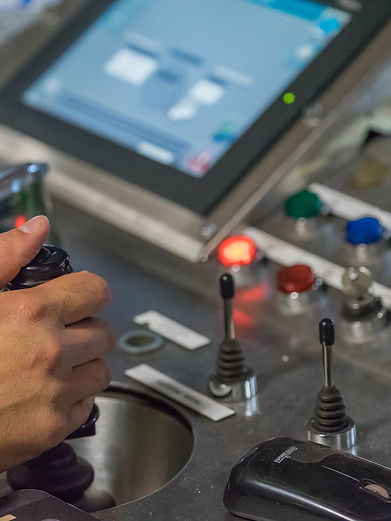
w3Synergy membrane separation systems come standard with preconfigured controller. Also available is fully automated systems with the option of either Allen Bradley, Siemens or Idec PLC. Automation allows for remote continuous online monitoring & control.
Available on-line instrumentation includes:
-
UV intensity monitor
-
TOC analyzer
-
Bioburden
-
Chlorine
-
pH
-
ORP
-
Conductivity
-
Resistivity
-
Turbidity
-
Pressure
-
Flow