


water Clean.
watts Green.
waste Lean.
GROUNDWATER
Many municipalities and water districts across the nation are facing climate-driven impacts on the quantity and quality of the water that they supply and deliver. California is experiencing a prolonged drought with several of the driest months in the historical record. In response, localities and industries are proactively (or reactively) identifying alternative and supplemental sources to supply their feed water needs. These alternate water supplies may derive from groundwater, lakes, rivers, stormwater, seawater, or even wastewater.
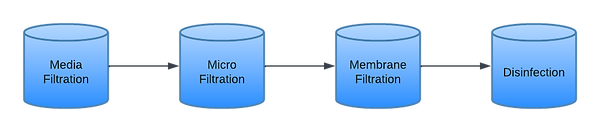
A packaged groundwater treatment system engineered by w3Synergy can be defined as a treatment train comprised of an array of separation technologies. The process steps specifically used for groundwater are categorized as follows:
.png)
Media Filtration
Seawater often contains suspended solids (TSS) in the form of algae, colloids, silts, and inorganic and organic matter that affect the clarity of the water. The range of TSS found in seawater is seasonally-influenced and varies based on the location of intake.
This turbidity can be measured with a turbidimeter and is expressed in nephelometric turbidity units (NTU). Silt density index (SDI) is a common measurement of the fouling potential of suspended solids found in seawater. Sand filtration and multimedia filtration (anthracite) are common methods of removing TSS. W3Synergy also offers zeolite filtration as a more efficient means of media filtration providing 50 to 100% higher solids loading capacity.
In some locations groundwater may have high concentrations of iron, manganese and/or hydrogen sulfide. A greensand media filter is an effective treatment to remove these constituents from the water. Whereas greensand is typically a silica sand core coated with manganese dioxide, w3Synergy uses a solid manganese dioxide media which lasts much longer than standard greensand.
Organic compounds including tannins (humic and fumic acids) can be found in groundwater pumped from wells screened closer to the surface. The presence of organic material can contribute to odor or color in the water. Odor is measured in TON and color is measured in color units. Granulated activated carbon (GAC) media is typically used to remove these types of organics from the water. GAC is also an effective method of removing manmade chemicals such as per- and polyfluorinated substances (PFAS).
“Softener” media containing ion exchange (IX) resin is used for groundwater containing high levels of hardness (caused by the presence of calcium and magnesium ions). In cases where arsenic concentrations exceed drinking water levels, selective IX resin is available from w3Synergy. Selective IX resin is also available to remove PFAS.
Microfiltration
w3Synergy provides cartridge and bag filtration with pore sizes ranging from 1 micron to 100 microns. Validated 1-micron absolute filters are also available for projects requiring demonstrated LT2 removal of microorganisms and pathogens including giardia, crypto, viruses, and e. coli.
Membrane Filtration
W3Synergy fabricates a broad range of membrane filtration equipment including ultrafiltration, nanofiltration, and reverse osmosis.
Ultrafiltration is used to remove suspended solids (TSS), colloidal material, and log removal of microorganisms and pathogens including giardia, crypto, viruses and e. coli.
Nanofiltration membranes are tighter than UF membranes but looser than RO membranes. NF is used to remove color due to dissolved organics and soften water by removing hardness ions (calcium & magnesium). Nanofiltration is also used to remove other divalent ions such as sulfate. In addition, nanofiltration (as well as reverse osmosis) has been extremely effective at removing PFAS.
Reverse osmosis is used to lower the level of total dissolved solids (TDS) in surface water due to the presence of ions, salts, and minerals found in the water. Waters containing TDS levels higher than 500 ppm are generally considered to be brackish. Conductivity expressed as microsiemens per centimeter (uS/cm) is another method of monitoring the presence of these dissolved solids.
Disinfection
After the water has been filtered, disinfection is an additional method used to kill any remaining pathogens including parasites, bacteria, or viruses.
w3Synergy supplies different alternatives for disinfection including UV, ozone, and chemical (i.e.chlorine) to meet the log removal requirements for giardia, crypto, viruses, and e. coli.
Clean-In-Place
w3Synergy fabricates both pre-engineered and custom-designed CIP skids for periodic cleaning of RO membrane systems, process & storage tanks, piping, and/or fermentation reactors. The chemical tanks and pumps on the skid are sized consistent with the application.
Automation
w3Synergy ingredient water treatment systems are fully automated with the option of either Allen Bradley, Siemens or Idec PLC. Automation allows for remote continuous online monitoring & control.
Contact Us
w3Synergy is ready to help you with your next water purification or water reuse project.
Contact our engineering team to learn more:
858.215.4122