


water Clean.
watts Green.
waste Lean.

INGREDIENT WATER
w3Synergy designs and fabricates the water treatment equipment required by the beverage industry including bottlers, breweries, processers, and co-packers to supply purified ingredient water for bottled water, and carbonated soft drinks (CSD), juices, and beer.
Beverage manufacturers require onsite treatment of locally-supplied water at the facility.
w3Synergy ingredient water systems provide consistency in product taste and safety while maximizing the efficiency of water and energy usage.
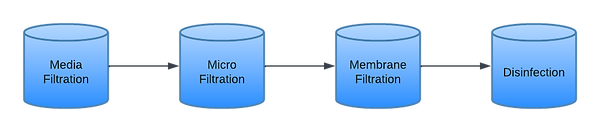
A packaged ingredient water system engineered by w3Synergy can be defined as a treatment train comprised of an array of separation technologies. The process steps specifically used for ingredient water are categorized as follows:
.png)
Media Filtration
Chlorine, chloramine, and bromine are disinfectants used in waters supplied by municipalities. Granulated activated carbon (GAC) media is typically used to remove these types of organics from the water. GAC is also an effective method of removing manmade chemicals such as per- and polyfluorinated substances (PFAS).
“Softener” media containing ion exchange (IX) resin is used for surface waters containing high levels of hardness (caused by the presence of calcium and magnesium ions). Selective IX resin is also available to remove PFAS.
Microfiltration
w3Synergy provides cartridge and bag filtration with pore sizes ranging from 1 micron to 100 microns. Validated 1-micron absolute filters are also available for projects requiring demonstrated LT2 removal of microorganisms and pathogens including giardia, crypto, viruses, and e. coli.
Membrane Filtration
W3Synergy fabricates a broad range of membrane filtration equipment including ultrafiltration, nanofiltration, and reverse osmosis.
Ultrafiltration is used to remove suspended solids (TSS), colloidal material, and log removal of microorganisms and pathogens including giardia, crypto, viruses and e. coli.
Nanofiltration membranes are tighter than UF membranes but looser than RO membranes. NF is used to remove color due to dissolved organics and soften water by removing hardness ions (calcium & magnesium). Nanofiltration is also used to remove other divalent ions such as sulfate. In addition, nanofiltration (as well as reverse osmosis) has been extremely effective at removing PFAS.
Consistency of the ingredient water within a beverage product regardless of the manufacturer’s (or co-packer’s) location is controlled through RO. Reverse osmosis is used to lower the level of total dissolved solids (TDS) in surface water due to the presence of ions, salts, and minerals found in the water. Waters containing TDS levels higher than 500 ppm are generally considered to be brackish. Conductivity expressed as microsiemens per centimeter (uS/cm) is another method of monitoring the presence of these dissolved solids.
w3Synergy beverage systems utilize the latest energy-saving low pressure RO membranes along with variable-frequency drives on our pump motors. To reduce the use of supply or makeup water, w3Synergy skids incorporate integrated concentrate recovery which cuts in half the quantity of brackish water discharged to the sewer.
Disinfection
After the water has been filtered, disinfection is an additional method used to kill any remaining pathogens including parasites, bacteria, or viruses.
w3Synergy supplies different alternatives for disinfection including UV, ozone, and chemical (i.e.chlorine) to meet the log removal requirements for giardia, crypto, viruses and e. coli.
Treated Water Storage and Distribution
w3Synergy fabricates custom-designed Storage & Distribution Systems specific to our clients needs and requirements. The components of these systems typically include RO Permeate Storage Tank, Distribution Pump and Disinfection Loop.
A UV sterilizer provides disinfection of pathogens and is sized based on the desired rate of circulation through the loop. The injection of ozone into the storage tank is sometimes specified to sanitize the recirculating loop. Residual ozone can subsequently be destroyed by the UV lamp prior to utilization of the purified water by the production facility.
Clean-In-Place
w3Synergy fabricates both pre-engineered and custom-designed CIP skids for periodic cleaning of RO membrane systems, process & storage tanks, piping, and/or fermentation reactors. The chemical tanks and pumps on the skid are sized consistent with the application.
Automation
w3Synergy ingredient water treatment systems are fully automated with the option of either Allen Bradley, Siemens or Idec PLC. Automation allows for remote continuous online monitoring & control.
Contact Us
w3Synergy is ready to help you with your next water purification or water reuse project.
Contact our engineering team to learn more:
858.215.4122